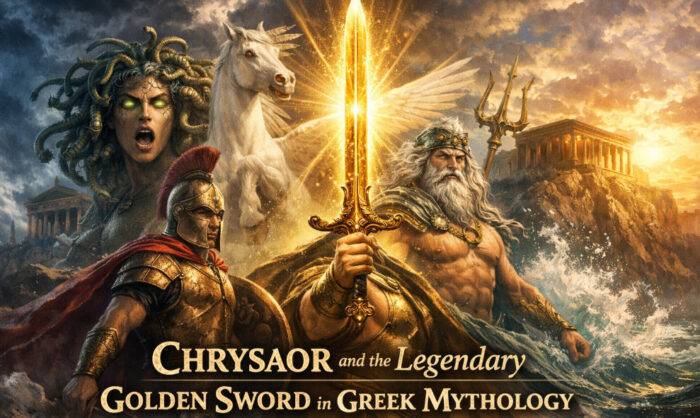
Chrysaor and the Golden Sword in Greek Mythology
Chrysaor and the Legendary Golden Sword in Greek Mythology: Origin, Meaning, and Symbolism
In the vast and powerful world of Greek mythology, few figures are as mysterious and symbolically rich as Chrysaor, the legendary warrior whose name literally means “he who bears the golden sword.” Though often overshadowed by his famous winged brother Pegasus, Chrysaor holds a unique place in ancient myth as a divine-born warrior associated with one of the most fascinating mythological weapons — the Golden Sword.
This in-depth guide explores the origins of Chrysaor, the meaning behind his golden blade, and why this mythological figure continues to inspire modern fantasy, storytelling, and legendary weapon lore.
Who Was Chrysaor in Greek Mythology?
Chrysaor was born under extraordinary circumstances. According to classical myth, he emerged fully formed from the blood of Medusa at the very moment she was slain by the hero Perseus. His father was Poseidon, the powerful god of the sea. Alongside him was born Pegasus, the immortal winged horse.
Unlike Pegasus, who appears frequently in art and legend, Chrysaor remains a more enigmatic character. However, his name itself provides powerful insight into his mythological identity. Derived from ancient Greek words meaning gold and sword, Chrysaor translates to “Golden Sword Bearer” or “He of the Golden Blade.”
This direct association with a divine weapon makes him one of the most symbolically important figures connected to legendary swords in Greek mythology.
The Golden Sword: Meaning and Symbolism
Although ancient texts do not describe detailed battles fought by Chrysaor, the symbolism of his Golden Sword carries deep mythological meaning.
1. Gold as a Symbol of Divine Power
In ancient Greek culture, gold symbolized immortality, divine authority, and celestial perfection. Unlike iron or bronze, gold does not rust or decay, making it a natural representation of eternal power.
A golden weapon suggests not just physical strength, but divine legitimacy — a warrior chosen or empowered by higher forces. In this sense, Chrysaor’s sword represents supernatural authority and godly lineage.
2. The Sword as a Warrior Archetype
Across global mythology, swords represent honor, courage, and heroism. From legendary Greek heroes to medieval knights, the blade is often a reflection of the warrior’s spirit.
The Golden Sword of Chrysaor fits into this universal archetype. It evokes imagery of a radiant, unstoppable warrior — a being born from both divine and monstrous origins, carrying a weapon that symbolizes transformation through conflict.
3. Birth from Death: A Powerful Mythic Motif
Chrysaor’s birth from Medusa’s blood represents a deeper theme found throughout mythology: creation emerging from destruction. While Medusa’s death marks the end of a monstrous threat, it simultaneously brings forth new life — Pegasus and Chrysaor.
In this context, the Golden Sword can symbolize renewal, strength forged through chaos, and the duality of beauty and terror in myth.
Chrysaor’s Lineage and Mythological Connections
Though not the focus of epic adventures like Hercules or Perseus, Chrysaor plays an important genealogical role in Greek mythology.
Father: Poseidon, god of the sea
Mother: Medusa, one of the Gorgons
Sibling: Pegasus, the winged horse
Spouse: The Oceanid Callirrhoe
Child: Geryon, the three-bodied giant later defeated by Heracles
Through his son Geryon, Chrysaor becomes indirectly connected to the famous Twelve Labors of Heracles. This lineage strengthens his position within the broader mythological universe.
The Golden Sword in Modern Fantasy and Mythology Culture
In modern fantasy literature, video games, and pop culture adaptations, the concept of a golden sword remains extremely popular. High-search terms such as:
Greek mythology weapons
Legendary swords in ancient myths
Golden sword meaning
Divine weapons in mythology
Mythical warriors and enchanted blades
continue to generate interest among readers and collectors.
The figure of Chrysaor fits seamlessly into these themes. As audiences seek deeper lore behind mythological weapons, his identity as the “Golden Sword Bearer” provides rich symbolic material for reinterpretation.
From tabletop games to fantasy novels, the archetype of the radiant golden blade continues to echo ancient storytelling traditions.
Why Chrysaor Still Matters Today
Chrysaor may not headline epic battles, but his myth embodies powerful symbolic layers:
Divine heritage
Transformation through violence
The eternal symbolism of gold
The archetype of the mythic warrior
His Golden Sword stands as a metaphor for inherited power and the mysterious intersection between gods and mortals.
For enthusiasts of Greek mythology, legendary weapons, and ancient warrior symbolism, Chrysaor offers a compelling figure worthy of deeper exploration.
Final Thoughts
The legend of Chrysaor and his Golden Sword reminds us that mythology is not only about famous heroes, but also about symbolic figures who represent deeper ideas. Born from the blood of Medusa and tied to the sea god Poseidon, Chrysaor embodies duality — beauty and terror, divinity and mortality.
His Golden Sword remains a timeless image within the study of mythological weapons, representing power, immortality, and the enduring human fascination with legendary blades.
For those exploring ancient myths, divine warriors, and the origins of legendary swords, the story of Chrysaor offers a powerful and unforgettable chapter in the world of Greek mythology.
https://www.coolkatana.com/