Excalibur & King Arthur: The Legendary Sword of Myth
Excalibur & King Arthur: The Legendary Sword That Defined British Myth and Medieval Lore
Why Excalibur Is King Arthur’s Most Famous Sword in Myth, History & Fantasy Culture
Across world mythology and medieval history, few legendary weapons have captured the imagination like Excalibur, the enchanted sword of King Arthur. More than just a blade, Excalibur symbolizes royal power, divine right of kings, and the heroic ideals of chivalry — making it one of the most enduring icons in British folklore, Arthurian stories, and heroic fantasy literature.
For sword enthusiasts, history buffs, and fantasy fans alike, Excalibur is a cultural touchstone — blending magic, myth, symbolism, and the timeless appeal of heroic narrative. In this comprehensive exploration, we examine the sword’s origins, its role across Arthurian legend, and why Excalibur myths still influence modern books, movies, games, and fantasy weapon lore.
Excalibur vs. The Sword in the Stone: Two Legendary Mythical Blades
When discussing King Arthur’s legendary sword, it’s critical to separate Excalibur from the Sword in the Stone — both central motifs in Arthurian legends but with distinct meanings.
In early medieval British tales, the Sword in the Stone proves Arthur’s rightful kingship. According to the story, only the true heir to the throne could pull a sword magically embedded in a stone — a test that Arthur alone succeeds at, marking the beginning of his rise to power.
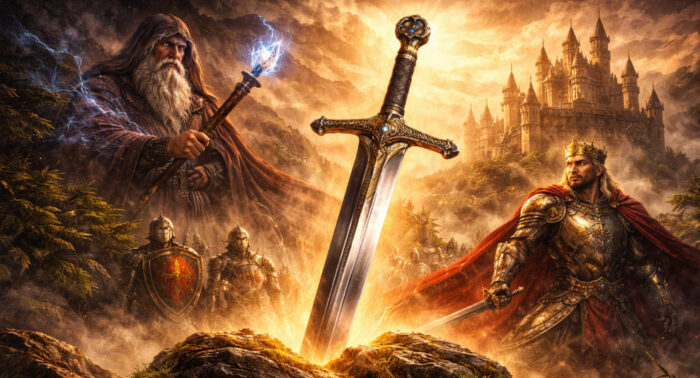
In contrast, the sword usually known as Excalibur is given not through a test of strength but through divine blessing: when Arthur’s first sword breaks in battle, the Lady of the Lake emerges from mystical waters and bestows upon him Excalibur — a weapon of magical origin and supreme symbolic importance.
This distinction — between the sword that confirms rulership and the sword that empowers it — is a central theme in medieval Arthurian myth and later fantasy storytelling.
The Lady of the Lake & Excalibur’s Magical Attributes
Excalibur is far more than an ordinary sword. According to legend:
Its blade shines with supernatural brilliance and is said to cut through the strongest armor.
The scabbard — often overlooked — is described as even more powerful than the sword, protecting its bearer from fatal wounds.
These elements made Excalibur a symbol of mythic power, mystical sovereignty, and supernatural legitimacy — representing not just physical might but also divine protection over a king’s rule.
Magical swords like Excalibur in folklore reflect ancient beliefs about kingship, fate, and the tight bonds between rulers and the forces of the divine or natural world.
Camelot, Knights of the Round Table & the Sword of Justice
During King Arthur’s reign, Excalibur became more than a weapon — it became a symbol of justice, honor, and moral leadership. With Camelot as his seat, Arthur used this legendary sword in defense against enemies and as a standard for his knights, most famously the Knights of the Round Table.
Unlike typical medieval warfare imagery, Arthur’s use of Excalibur emphasizes ethical kingship — courage tempered with wisdom, loyalty with humility, and strength guided by virtue. This is why the Excalibur myth resonates so deeply, embodying the hero’s journey, ethical leadership, and the eternal quest for justice — themes repeated across western literature and fantasy genres.
The Tragic Legend: Excalibur’s Return and the Fall of King Arthur
No myth is complete without an ending. After the betrayal by Mordred and the tragic Battle of Camlann, King Arthur is mortally wounded and instructs his loyal knight, Sir Bedivere, to return Excalibur to the Lady of the Lake. After initial hesitation, Bedivere casts the sword into the water, where a glowing hand rises to reclaim it — marking the end of Arthur’s reign and the symbolic closure of the old hero age.
This closing scene reinforces two enduring themes:
The cyclical nature of heroic eras
The return of divine gifts to their source
Both add depth and poignancy to the legend of Excalibur and its place in mythic history.
Excalibur’s Enduring Legacy in Popular Culture & Fantasy Media
Long after medieval times, Excalibur has remained a staple of modern popular culture:
Films like Excalibur and King Arthur: Legend of the Sword reimagine the myth for new audiences.
In novels and fantasy literature, countless authors draw on Excalibur’s symbolism.
Video games and anime frequently feature Excalibur-like “hero’s swords” as metaphors for destiny and justice.
Even observable in film adaptations such as The Kid Who Would Be King, where the ancient sword resurfaces in modern settings.
This persistent presence in culture — from Arthurian books to blockbuster entertainment — highlights how deeply Excalibur’s legend has imprinted itself on global storytelling.
Historical Roots & Etymology of Excalibur
The name Excalibur itself comes from older linguistic roots. In early Welsh myth, the sword was known as Caledfwlch, and later Latin authors called it Caliburnus before the medieval French and English forms evolved.
Such linguistic evolution mirrors the legend’s transformation over centuries — from Celtic tales of magical weapons to medieval romances, and finally to today’s popular fantasy archetypes.
Conclusion: The Timeless Power of the Sword Excalibur
Excalibur — the legendary magical sword of King Arthur — is more than myth. It stands as a cultural symbol of leadership, destiny, justice, and the hero’s journey across centuries of storytelling. From the mystical waters of the Lady of the Lake to the glittering pages of fantasy novels and films, Excalibur continues to captivate and inspire.
Understanding this iconic sword provides insight into how mythology, medieval lore, and heroic symbolism shape not only ancient stories but the very foundations of modern fantasy and cultural imagination.
https://www.coolkatana.com/