Misericorde Dagger Explained: Medieval Armor-Piercing Mercy Blade Guide
What Is the Misericorde Dagger? Medieval “Mercy Blade” Explained
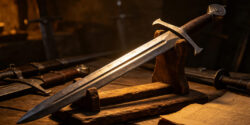
The misericorde dagger, often called the “mercy dagger” or “blade of mercy”, is one of the most fascinating secondary weapons of the medieval world. Used primarily by knights in the High Middle Ages, this long, narrow dagger was designed not for slashing, but for precise thrusting into the weak points of armor. Despite its grim purpose, its name comes from the Latin misericordia, meaning mercy, reflecting its historical role in ending suffering on the battlefield.
Today, the misericorde is widely studied in medieval weapons history, European knight combat systems, and armor-piercing dagger design, making it a highly searched topic among collectors, historians, and fantasy enthusiasts.
Origins of the Misericorde Dagger in Medieval Europe
The misericorde first appeared around the 12th century during a time when plate armor was becoming more common across Europe. Traditional swords were no longer reliable for finishing off heavily armored opponents, which led to the development of specialized piercing weapons.
Knights needed a compact secondary weapon that could:
- Exploit gaps in armor
- Deliver precise finishing strikes
- Work effectively in close combat
This is where the misericorde became essential in medieval knight weapon systems and battlefield survival tactics.
It was widely used across regions such as England, France, Germany, and parts of Eastern Europe.
Why Is It Called the “Mercy Blade”?
The term misericorde comes from Latin and Old French, meaning “act of mercy” or “compassion.”
This may seem ironic for a weapon, but in medieval warfare the meaning was practical:
- Many wounded knights suffered fatal injuries without quick death
- Medical care on battlefields was extremely limited
- Prolonged suffering was considered dishonorable or unnecessary
The misericorde was used to deliver a coup de grâce, a final strike meant to end suffering quickly and decisively.
In this context, “mercy” referred not to sparing life, but to ending pain.
Design and Structure: Built to Pierce Armor
The misericorde dagger was engineered for one purpose: penetrating armor gaps with maximum efficiency.
Key structural features:
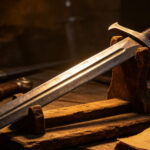
- Long, narrow, rigid blade
- Triangular, square, or lozenge-shaped cross-section
- Minimal or no cutting edge
- Reinforced spine for strength
- Compact handle for close-quarters control
Because of this design, it could slip through:
- Armpit joints
- Helmet eye slits
- Groin openings
- Weak points in chainmail or plate armor
This made it one of the most effective armor-piercing medieval daggers in history.
Battlefield Use: How Knights Used the Misericorde
On the battlefield, the misericorde was typically a secondary weapon carried alongside swords, shields, or polearms.
Common uses included:
- Finishing wounded enemies
- Close-range grappling combat
- Executing incapacitated opponents
- Occasionally forcing surrender during capture
When a knight was pinned or disarmed, the misericorde became a decisive tool in close-quarters medieval combat scenarios.
In some cases, it was even used during tournaments or jousting events to end injured combatants quickly.
Misericorde vs Other Medieval Daggers
The medieval world had several dagger types, but the misericorde stood out due to its specialized function.
- The rondel dagger was more balanced for general combat
- The stiletto evolved later with assassination-focused use
- The bollock dagger served civilian and personal defense roles
Compared to these, the misericorde was uniquely focused on armor penetration and mercy killing, making it more specialized than most medieval blades.
Symbolism and Knightly Status
Beyond its battlefield role, the misericorde also carried symbolic meaning.
For knights, it represented:
- Honor in combat
- Control over life and death
- Duty to end suffering
- Nobility in warfare ethics
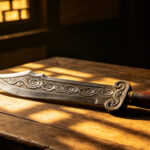
Many high-status versions were decorated with:
- Engraved handles
- Ivory or bone inlays
- Ornamental pommels
- Fine craftsmanship reflecting rank
It was not just a weapon—it was part of a knight’s identity and moral code.
Misericorde in Modern Popular Culture
Although the age of armored knights is long gone, the misericorde remains popular in modern media and collecting culture.
It frequently appears in:
- Medieval films and historical dramas
- Fantasy games and RPGs
- Dark fantasy storytelling
- Museum weapon collections
- Replica and cosplay weapon markets
In video games, it is often portrayed as a high critical damage dagger, emphasizing its historical role as a finishing weapon.
Conclusion: The Legacy of the Medieval Mercy Dagger
The misericorde dagger represents a unique intersection of engineering, warfare, and medieval ethics. It was designed to solve a very specific problem: how to end the life of a heavily armored, wounded opponent quickly and efficiently.
While its purpose may seem harsh by modern standards, in the context of medieval battlefields it reflected a complex understanding of mercy, honor, and practicality.
Today, the misericorde remains one of the most iconic examples of a medieval armor-piercing dagger, continuing to fascinate historians, collectors, and enthusiasts of European martial history.
https://www.coolkatana.com/