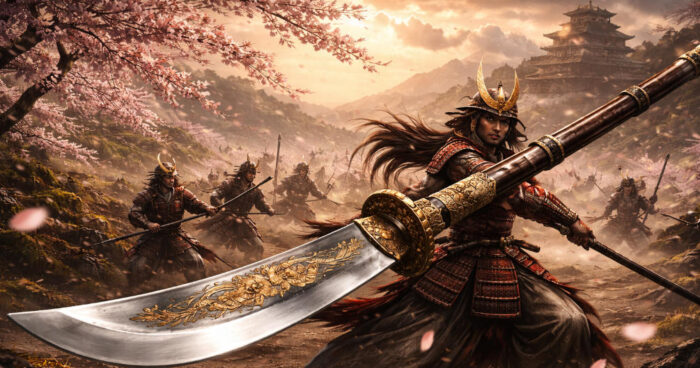
Naginata Weapon History: Samurai Polearm and the Rise of Female Warriors
What Made the Naginata a Unique Samurai Weapon and a Symbol of Female Samurai Power?
When people think of weapons from Japan’s feudal era, the iconic katana usually takes center stage. However, among traditional Japanese weapons, one long-handled blade stands apart for both its battlefield dominance and cultural symbolism—the Naginata. Combining spear-like reach with sword-like cutting ability, the Naginata was not only a devastating polearm in war but also a lasting emblem of samurai class, martial discipline, and female warrior strength.
As one of the most recognizable Japanese polearms, the Naginata occupies a unique position in the evolution of samurai weapons and Japanese martial arts history.
What Is a Naginata? Curved Steel and the Physics of Lethality
The Naginata is a traditional Japanese long-handled weapon consisting of a curved, single-edged blade mounted on a wooden shaft. This blade profile, known as Naginata-zukuri, distinguishes it from straight spears and grants it superior slicing capability.
Unlike European polearms designed primarily for thrusting, the Naginata excels in wide, circular slashing motions. Its extended handle allows the wielder to generate tremendous centrifugal force, producing powerful sweeping strikes capable of controlling space and keeping enemies at a lethal distance. This made the Naginata especially effective against infantry formations and mounted opponents.
By combining reach, momentum, and blade geometry, the Naginata functioned as both a cutting sword and a battlefield control weapon—an ideal solution for open-field combat.
Precision Design: Built for Balance, Feedback, and Control
The Naginata’s shaft is traditionally oval-shaped rather than round, increasing durability while allowing the user to feel blade alignment through grip alone—an essential advantage in fast-moving combat. At the base of the handle sits a metal Ishizuki, enabling strikes, balance adjustments, and defensive maneuvers using the weapon’s rear end.
Every design choice reflects Japanese weapon craftsmanship focused on efficiency, control, and adaptability, reinforcing the Naginata’s reputation as one of the most technically refined samurai weapons.
From Ō-Naginata to Ko-Naginata: The Weapon’s Evolution
As Japanese warfare evolved, so too did the Naginata:
Ō-Naginata (Large Naginata)
Prominent during the late Heian and Kamakura periods, these massive blades featured deep curvature and long shafts. They were designed for battlefield dominance, capable of cutting down foot soldiers and disabling cavalry by striking horses’ legs.
Ko-Naginata (Small Naginata)
Later periods favored lighter, more maneuverable designs. Shorter blades with refined balance allowed quicker transitions and precision strikes. This version became closely associated with Onna-musha, or female samurai warriors.
This evolution reflects how Japanese polearms adapted to shifting combat tactics and social structures.
Traditional Sword Forging: Tamahagane Steel and Samurai Craftsmanship
High-quality Naginata blades were forged using Tamahagane steel, the same material used in authentic Japanese swords. Through repeated folding and differential hardening, smiths created blades with a hard cutting edge and a resilient spine.
This forging process allowed the Naginata to penetrate armor gaps, slice through leather and cloth armor, and withstand prolonged combat. Functionally, it was a long-handled Japanese sword, blending spear reach with katana-level cutting performance.
Sohei and Samurai: The Naginata on the Battlefield
The Naginata gained early prominence among Sohei (warrior monks) during the late Heian period. These monks relied on the weapon’s range and sweeping power to defend temples and control narrow approaches, often overcoming numerically superior forces.
By the Kamakura and Muromachi periods, the Naginata became a standard samurai battlefield weapon. Against cavalry charges, infantry wielding Naginata could disrupt formations and pull mounted warriors into close combat.
Legendary female warriors such as Tomoe Gozen became synonymous with Naginata mastery, cementing the weapon’s legacy as both fearsome and elegant.
From War to Symbol: The Naginata and Samurai Women
During the peaceful Edo period, large-scale warfare declined. Spears (Yari) replaced Naginata in military formations, while the Naginata found a new role within samurai households.
Samurai women were trained in Naginata-jutsu as a means of home defense. The weapon’s reach compensated for physical differences, allowing women to confront armored attackers effectively. Over time, finely crafted Naginata became ceremonial objects and dowries, symbolizing honor, discipline, and the duty to protect one’s family.
This transformation elevated the Naginata into a lasting icon of female empowerment in Japanese history.
Naginata vs. Katana: Battlefield Function and Tactical Roles
While both weapons represent the pinnacle of Japanese blade forging, their purposes differ significantly. The Katana excels in close-quarters combat and dueling, while the Naginata dominates open spaces through reach and area control.
A skilled Naginata user can maintain a continuous threat zone of nearly two meters, making it difficult for shorter weapons to close in. However, in confined environments such as corridors or dense forests, its length becomes a disadvantage—one reason samurai traditionally trained with multiple weapon types.
Modern Naginata: Martial Art, Discipline, and Cultural Legacy
Today, the Naginata lives on through Naginata-do, a modern martial art emphasizing posture, timing, and spiritual focus. Practitioners use bamboo training blades and protective armor to refine technique safely.
Naginata-do remains especially popular among women, preserving the legacy of female samurai while promoting balance, confidence, and discipline. It represents the fusion of historical combat and modern self-cultivation.
Hand Forged Japanese 47-Inch Naginata Sword
1095 High Carbon Steel Blade · Alloy Tsuba
SHOP NOW
Conclusion: The Enduring Power of the Naginata
The Naginata is more than a traditional Japanese weapon—it is a living testament to Japan’s martial heritage. From warrior monks and battlefield samurai to female defenders of the home, its story mirrors the evolution of Japanese society itself.
Elegant yet devastating, practical yet symbolic, the Naginata stands as one of Japan’s most important weapons beyond the katana. For collectors, martial artists, and historians exploring Japanese weapon culture, the Naginata remains an essential chapter in the legacy of the samurai.
Hand Forged Japanese 47inch Naginata Sword 1095 High Carbon Steel Blade Alloy Tsuba