Were China’s Hook Swords Real Weapons or Just Movie Fantasy?
Were China’s Hook Swords Real Weapons or Just Movie Fantasy?
The Truth Behind Chinese Hook Swords (Shuang Gou) in History, Combat, and Martial Arts
Are the Chinese hook swords seen in films like Crouching Tiger, Hidden Dragon or video games such as Mortal Kombat nothing more than cinematic exaggeration?
The short answer is no—they are very real.
This in-depth guide explores the historical hook sword weapon, known in Chinese as Shuang Gou or Tiger Head Hook Swords, uncovering their origins, real combat purpose, lethal four-part design, and why they remain one of the most fascinating traditional Chinese cold weapons today.
From martial arts lineages to weapon collectors, hook swords occupy a rare space where function, strategy, and spectacle intersect.
What Are Hook Swords? (Chinese Hook Sword Explained)
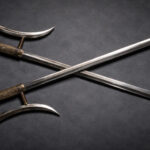
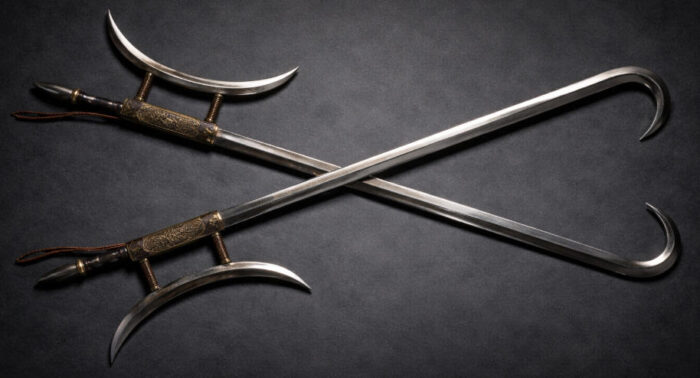
Hook swords, also called Chinese twin hook swords, are paired short weapons featuring:
A curved hook blade at the tip
A crescent-shaped hand guard (often sharpened)
A straight cutting edge along the blade
A spiked pommel for close-range thrusting
In Chinese, they are referred to as Hu Tou Gou (Tiger Head Hooks) or Shuang Gou (Double Hooks).
Unlike conventional swords designed mainly for cutting or thrusting, hook swords specialize in trapping, disarming, and controlling an opponent’s weapon, making them especially effective in close-quarters combat.
Are There Hook Swords in Other Cultures?
Europe: Some medieval swords featured hooks or notches, but none developed into a standardized hook-based weapon system.
Japan: Traditional Japanese weapons do not include true hook swords. Most hook-style blades in anime or fantasy are loosely inspired by Chinese designs.
This makes the Chinese hook sword a uniquely regional and culturally specific weapon.
I. Core Verdict: Yes, Hook Swords Were Real—But Highly Specialized
Let’s clear the biggest misconception right away:
Chinese hook swords are authentic historical weapons, not modern fantasy creations.
They are officially listed among the Eighteen Traditional Chinese Martial Weapons and appear in advanced systems such as:
Northern Shaolin Kung Fu
Seven-Star Praying Mantis
Baguazhang
That said, their role was never mainstream military issue.
1. Not Battlefield Weapons—But Duelist and Specialist Arms
On ancient Chinese battlefields dominated by spears, halberds, and sabers, hook swords were rare.
Why?
Formation Limitations: Hook sword techniques rely on wide arcs, spinning motions, and weapon entanglement—dangerous in tight troop formations.
Training Difficulty: Mastering paired hook swords requires exceptional coordination, timing, and strength.
Production Cost: Their complex geometry made them inefficient for mass military supply.
As a result, hook swords thrived outside formal armies, not within them.
2. The Weapon of Civilian Martial Artists & Escort Guards
The true rise of hook swords occurred during the late Qing Dynasty and Republican era, particularly among:
Civilian martial artists
Armed escort agencies (Biao Ju)
Bodyguards and caravan protectors
Countering Long Weapons
Bandits often relied on spears or staffs. Hook swords excelled at:
Hooking spear shafts
Locking and twisting weapons away
Closing distance instantly
This perfectly embodies a classic Chinese martial principle:
“Use the short to defeat the long; use the unconventional to overcome the orthodox.”
The crescent guard also functioned as a mini shield, offering exceptional personal defense.
II. Why Hook Swords Are So Deadly: The Four-Weapon-in-One Design
What makes the Shuang Gou one of the most unusual bladed weapons in history is its four integrated combat functions.
1. The Hook (Disarm & Control)
Designed primarily for catching weapons, not slashing
Can lock blades, snag limbs, or pull opponents off balance
2. The Main Blade (Cutting & Parrying)
Sharpened edge allows standard sword techniques
Effective for slicing, deflecting, and pressure cuts
3. Crescent Guard (Close-Range Slicer)
Protects the hand
Often sharpened for devastating short-range attacks during grappling
4. Pommel Spike (Hidden Dagger)
Used for reverse stabs when enemies breach the guard
Especially effective in clinch-range encounters
Few historical weapons combine control, offense, defense, and deception so completely.
III. The Legendary “Linking Hooks” Technique: Real or Movie Magic?
One of the most iconic scenes in Crouching Tiger, Hidden Dragon shows twin hook swords being linked together and swung like a bladed chain weapon.
This technique is real.
In traditional kung fu, it’s known as “Linking Hooks” (Gou Lian).
1. Tactical Physics: Range Deception Through Centrifugal Force
Hook swords are short-range weapons
When linked, they suddenly gain nearly 2 meters of reach
Opponents misjudge distance—often fatally
The spinning motion creates a sweeping kill zone, similar to meteor hammers, ideal for crowd control or leg attacks.
2. High Risk, High Reward
This maneuver is considered advanced and dangerous:
Hooks rely on centrifugal force—if blocked, they can disengage
The user’s centerline is briefly exposed
Best used as a finisher or emergency tactic
It perfectly reflects Chinese martial philosophy:
“Short weapons dominate in chaos; long weapons dominate through leverage.”
Hook swords uniquely exploit both.
IV. Why Hook Swords Are Popular with Modern Collectors
Even today, Chinese hook swords for sale are highly sought after by collectors and practitioners.
1. A Blacksmith’s Ultimate Challenge
Forging functional hook swords is extremely demanding:
Complex geometry with multiple cutting planes
Differential heat treatment for toughness at the hook and hardness at the edges
Structural integrity must remain flawless
High-quality hook swords represent elite-level craftsmanship.
2. Striking Display & Symbolism
Instantly stand out among katanas or straight swords
Associated with warding off evil and “hooking good fortune”
Often displayed crossed in studies or training halls
3. Advanced Kung Fu Weapon Training
Hook swords remain a pinnacle weapon in:
Northern Shaolin forms
Praying Mantis systems
Training develops:
Wrist strength
Circular footwork
Full-body coordination
Mastery symbolizes a deep understanding of strategy over brute force.
V. Final Verdict: Not Fantasy—Martial Ingenuity at Its Peak
Chinese hook swords are absolutely real weapons.
They were never meant to replace spears or sabers—but to outthink them. Their existence proves that historical martial arts valued cleverness, adaptability, and tactical intelligence as much as raw power.
Whether you are a martial artist, a cold weapon collector, or simply fascinated by historical arms, hook swords stand as one of the most ingenious—and misunderstood—weapons ever forged.
They are not fantasy.
They are strategy made steel.
https://www.coolkatana.com