Full Tang Samurai Swords: The Core of True Craftsmanship and Practical Power
In the world of traditional cold weapons, the Full Tang structure is universally recognized as a key indicator of a sword’s strength, reliability, and authenticity. Especially when it comes to handmade samurai swords that are intended for real use—whether for martial arts practice, cutting demonstrations, or even historical reenactments—the Full Tang design becomes the benchmark for assessing the durability, combat performance, and craftsmanship level of a sword. It is not just a technical specification but a reflection of the spirit of sword-making and the cultural essence embedded in Japanese sword traditions.
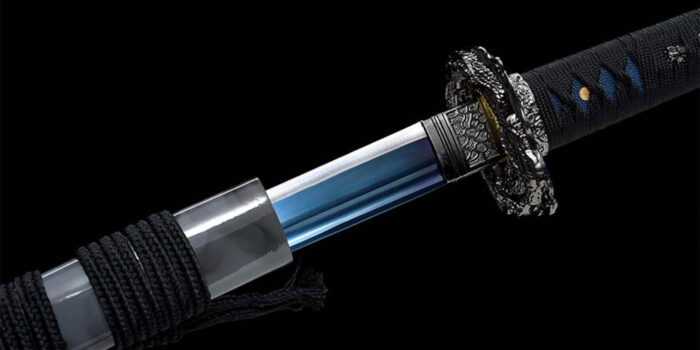
In this article, we’ll take the Handmade Japanese Samurai Sword (Dragon Pattern Blue Blade, 1060 High Carbon Steel, Bo-Hi, Clay Tempering) as a representative example to explore the full value and allure of Full Tang swords, examining their structural characteristics, material choices, functional advantages, and artistic design. This comprehensive analysis will reveal why Full Tang swords are considered the pinnacle of craftsmanship and a must-have for true sword enthusiasts.
What is a Full Tang Sword?
Full Tang refers to a time-honored forging method where the steel of the blade extends as a single, uninterrupted piece through the entire length of the handle. This structure ensures that the blade and the handle are integrally connected, creating a solid and unified body. Unlike other structures such as half-tang or hidden tang—where the blade only extends partially into the handle and is often joined by adhesives or pins—the Full Tang design guarantees structural integrity and long-lasting durability, especially under intense use.
The core difference lies in the connection strength. In half-tang and hidden tang designs, the joining point between the blade and handle becomes a weak spot. Over time, with repetitive cutting, slashing, or impact, these joints can loosen, crack, or even break apart, posing serious safety risks. In contrast, a Full Tang sword eliminates these structural weaknesses, making it capable of enduring rigorous training sessions, high-stress combat scenarios, and prolonged heavy-duty use without compromising stability or safety.
Moreover, the Full Tang design significantly enhances the weight balance and handling precision of the sword. Since the steel runs through the entire sword, from tip to pommel, the overall center of gravity is better aligned, giving the user a more intuitive and natural control during swings and strikes. This balance reduces wrist fatigue, allows for smoother transitions between offensive and defensive movements, and ensures that each cut is both accurate and powerful.
Throughout history, the Full Tang structure has been the gold standard for battle-ready swords, embodying not just practicality but also the aesthetic philosophy of Japanese sword-making, where every part of the sword—from the blade to the fittings—works in harmony as a single entity. For modern collectors and martial artists, owning a Full Tang sword represents not just possession of a superior weapon, but a profound connection to centuries of samurai culture and craftsmanship.
Advantages of Full Tang Structure
1. Exceptional Strength and Resistance to Breakage
The Full Tang construction ensures that the blade and handle are forged from one continuous piece of steel, forming a robust, unbreakable core. This seamless integration drastically enhances the sword’s ability to withstand high-impact collisions, powerful cutting motions, and intensive martial arts routines. Unlike swords with segmented structures, Full Tang swords retain their integrity even under prolonged stress, making them ideal for both serious combat applications and long-term usage. Whether you’re slicing through dense bamboo or performing advanced cutting drills, the Full Tang structure offers unmatched reliability.
2. Superior Combat Performance for Cutting Practice
In real-world combat scenarios or cutting demonstrations, a sword’s structural integrity directly impacts its performance. Full Tang swords are specifically designed to handle aggressive actions like slashing, hacking, and thrusting with unwavering stability. The blade remains firmly attached to the handle, preventing any wobbling or detachment, thus giving practitioners the confidence to execute powerful, precise techniques without fear of equipment failure. This makes Full Tang swords indispensable tools for martial artists focusing on Tameshigiri (test cutting) or Iaido practitioners seeking realistic training experiences.
3. Firm, Stable Grip—Handle Won’t Loosen or Detach
A key concern with non-Full Tang swords is the tendency of the handle to become loose after repetitive use. However, the Full Tang design eliminates this issue entirely. The tang is often secured with double Mekugi (bamboo pegs) and reinforced by wrapping techniques such as ray skin overlays and leather bindings, ensuring that the handle remains rock-solid, even after thousands of practice cuts. This stability is crucial not only for maintaining control and precision during maneuvers but also for ensuring user safety, reducing the risk of accidents caused by handle failures.
4. Perfectly Balanced Weight Distribution for Enhanced Handling
One of the most praised attributes of Full Tang swords is their superior weight distribution. Because the steel runs through the entire sword, the center of gravity is perfectly aligned, offering a harmonious balance that makes the sword feel like a natural extension of the user’s arm. This equilibrium enhances the practitioner’s ability to execute fluid, dynamic movements, whether performing fast swings or precise thrusts. Compared to swords with uneven weight distributions, Full Tang swords provide a much smoother, more agile handling experience, minimizing the strain on the wrist and improving overall combat efficiency.
COOLKATANA’s Craftsmanship: 1060 High Carbon Steel + Clay Tempering + Bo-Hi Groove
The Dragon Pattern Blue Blade Samurai Sword is a perfect embodiment of the fusion between traditional craftsmanship and modern aesthetics, combining high-performance materials with intricate design elements to deliver a sword that excels in both form and function.
1060 High Carbon Steel — Balanced Hardness and Flexibility
The blade is forged from 1060 high carbon steel, a material renowned for its 0.6% carbon content, offering a perfect balance between edge retention and flexibility. This steel is robust enough to maintain a razor-sharp edge, while still possessing enough elasticity to endure repetitive impacts without deforming or cracking. This makes 1060 steel an ideal choice for practitioners who require a sword that can withstand intense cutting practices yet remains sharp and reliable over time.
Clay Tempering (Yaki-Ire) — Enhanced Cutting Ability and Aesthetic Hamon
Employing the ancient Yaki-Ire (clay tempering) technique, the blade is coated with a specialized clay mixture before undergoing rapid quenching. This process creates a hard, razor-sharp edge while preserving the flexibility of the blade’s spine. The result is a sword with superior cutting and slashing performance, capable of withstanding significant lateral forces. Additionally, this method produces a distinctive Hamon (temper line)—a hallmark of traditional Japanese sword-making—which not only showcases the sword’s craftsmanship but also adds an aesthetic flair that makes each blade truly one-of-a-kind.
Bo-Hi (Blood Groove) — Weight Reduction and Sonic Aesthetics
The Bo-Hi groove, often referred to as a “blood groove,” serves a dual purpose: it reduces the overall weight of the blade, making it more agile and easier to maneuver, while also enhancing the acoustic feedback during swings. The distinct whooshing sound generated by the Bo-Hi when the sword slices through the air amplifies the psychological impact in demonstrations or sparring. Functionally, it eases the burden on the user’s wrist and arms during prolonged training, without compromising structural integrity.
Aesthetic Brilliance: Blue Blade, Dragon Pattern Fittings, and Symbolism
Beyond its superior performance, this sword’s design reflects a deep reverence for Eastern aesthetics and symbolic artistry, making it a striking piece both visually and culturally.
Blue Electroplated Blade — Modern Elegance Meets Traditional Weaponry
The blade’s surface is treated with a blue electroplating process, giving it a lustrous, iridescent sheen that shifts with the light. This treatment not only enhances the sword’s visual appeal but also provides a protective layer against rust and corrosion, ensuring long-lasting beauty. The blue hue symbolizes mystery, strength, and tranquility, making the sword an embodiment of both modern elegance and samurai stoicism.
Dragon Motif Tsuba and Fittings — Embodying Power and Nobility
Intricate dragon patterns adorn the Tsuba (guard), Fuchi, Kashira, and other fittings, symbolizing strength, authority, and divine protection in Eastern mythology. The dragon, revered as a bringer of prosperity and a guardian spirit, imbues the sword with a majestic aura, elevating it from a mere weapon to a cultural artifact that carries centuries of legendary symbolism.
Black Leather-Wrapped Handle with Ray Skin Underlay
The handle is meticulously wrapped in black leather, combined with a traditional ray skin (Samegawa) overlay, enhancing both grip comfort and tactile feedback. This design ensures a firm, non-slip hold, vital during high-intensity training sessions, while also paying homage to the classic aesthetics of Japanese sword craftsmanship.
Wooden Lacquered Scabbard with Dragon Motifs
Completing the sword’s design is a high-quality wooden scabbard, finished with a protective lacquer coating and decorated with dragon engravings. This not only protects the blade but also serves as an extension of the sword’s artistic expression, making it suitable for display, gifting, or ceremonial purposes.
Practical Applications and Collectible Value
This Full Tang Samurai Sword is not merely a showpiece—it’s a high-performance weapon designed for real-world use, making it an indispensable tool for various applications:
✅ Ideal for martial arts practitioners engaging in cutting, slashing, and Iaido training.
✅ A must-have for sword collectors seeking both functional and artistic value.
✅ An exquisite cultural gift or decorative centerpiece for themed environments or displays.
✅ Durable enough to serve as a film prop or for live-action reenactments.
✅ The Full Tang structure ensures long-term stability, offering peace of mind during high-intensity use.
Why Full Tang is the Only True Choice for Practical Swords
Among the myriad of modern replica swords available today, only those with a Full Tang construction can genuinely be called functional swords. While decorative swords with hidden tangs may suffice for display purposes, they lack the structural integrity to endure combat scenarios or cutting exercises safely. For practitioners who prioritize both safety and performance, a Full Tang sword is non-negotiable.
Conclusion: A Masterpiece of Functional Art and Traditional Craftsmanship
The Handmade Japanese Samurai Sword (Dragon Pattern Blue Blade, 1060 High Carbon Steel, Full Tang Structure) stands as a testament to the fusion of ancient sword-making techniques and modern design innovation. It embodies the relentless pursuit of perfection that defines traditional Japanese craftsmanship while delivering the combat capabilities and aesthetic allure demanded by modern collectors and martial artists. Whether you’re seeking a reliable practice sword, a stunning collectible, or a piece of cultural art, this sword is an unparalleled treasure that delivers on all fronts.
Handmade Japanese Samurai Katana, Dragon Sword Blue Blade with Bo-hi 1060 Carbon Steel Clay Tempered Dragon Pattern Fitting