Why do astronomers believe in dark matter?
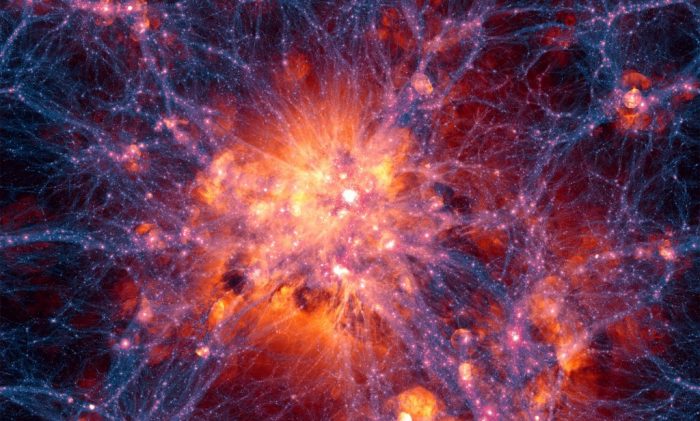
The universe is home to a dizzying number of stars and planets. But the vast bulk of the universe is thought to be invisible dark matter.
Illustris Collaboration, CC BY-NC
Dark matter, by its very nature, is unseen. We cannot observe it with telescopes, and nor have particle physicists had any luck detecting it via experiments.
So why do I and thousands of my colleagues believe most of the universe’s mass is made up of dark matter, rather than the conventional matter that comprises stars, planets, and all the other visible objects in our skies?
To answer that question, you need to appreciate what dark matter can and cannot do, understand where in the universe it lurks, and realise that “dark” is just the start of the puzzle.
Unseen influence
Our dark matter story starts with speed and gravity. Throughout the cosmos we see objects travelling in orbits under the influence of gravity. Just as Earth orbits the Sun, the Sun orbits the centre of our galaxy.
The speed required to keep a celestial body in orbit is a function of mass and distance. For example, in our Solar System, Earth moves at 30km per second, whereas the most distant planets dawdle at several kilometres per second.
Our galaxy is incredibly massive, so the Sun orbits at 230km per second despite being 26,700 light years away from our galaxy’s centre. However, as we move further from the centre of the galaxy, the orbital speeds of the stars remains roughly constant. Why?
Read more:
What a new map of the universe tells us about dark matter
Unlike our Solar System, whose mass is dominated by the Sun, mass in our galaxy is spread across thousands of light years. As one moves to larger distances from the galactic centre, the stars and gas enclosed within this radius increases. Can this additional mass explain the vast speeds of the most distant stars in our galaxy? Not quite.
In the 1960s, the pioneering US astronomer Vera Rubin measured the orbital speeds in the Andromeda galaxy (the galaxy next to the Milky Way) to distances of 70,000 light years from that galaxy’s core. Remarkably, despite this distance being well beyond the bulk of Andromeda’s stars and gas, the orbital speed remained near 250km/s.
This phenomenon isn’t unique to individual galaxies either. Back in the 1930s, Swiss-American astronomer Fritz Zwicky found that galaxies orbiting within galaxy clusters were moving far faster than expected.
What’s going on? One possibility is that a vast amount of unseen mass extends beyond the stars and gas. This is dark matter.
Indeed, the work of Zwicky, Rubin and subsequent generations of astronomers indicate there’s more dark matter in the universe than conventional matter. (As for dark energy, that’s a whole other story.)
VISIT – https://goemanbind.org/opinion-and-articles/why-do-astronomers-believe-in-dark-matter/