Were Bronze Swords Really Too Fragile for Real Combat?
Were Bronze Swords Really Too Fragile for Real Combat?
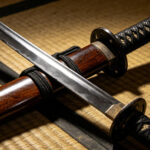
When people imagine bronze swords, they often picture corroded museum relics—green with patina, blunt, and seemingly decorative. Compared to the razor-sharp edge of a modern high-carbon steel katana, bronze is frequently dismissed as soft, weak, or merely a primitive transitional material.
Many weapon enthusiasts assume bronze swords would bend, chip, or shatter at the first clash, making them inferior to iron or steel weapons in every way.
But history tells a very different story.
For more than two thousand years, bronze swords dominated battlefields across Asia, Europe, and the Near East. From Mycenaean Greece to ancient China, elite warriors trusted bronze blades with their lives.
So the real question is:
Were bronze swords actually fragile—or is this a modern misunderstanding of ancient metallurgy?
Today, we return to the Bronze Age, breaking myths and uncovering the true combat potential of bronze weapons.
Is Bronze a Good Material for Swords?
In its historical context—yes. By modern standards—no.
Bronze is primarily an alloy of copper and tin, sometimes mixed with small amounts of lead, arsenic, or nickel. Compared with pure copper, bronze is significantly harder, more durable, and far more resistant to corrosion. Most importantly, it can be easily cast, making it ideal for early civilizations with limited forging technology.
Bronze Sword Performance in Combat
From a battlefield perspective, bronze swords were:
Sharp enough to cut flesh, leather armor, and light lamellar
Durable enough for real warfare, not ceremonial use
Highly effective in short-range combat
However, bronze does have limitations. It lacks the toughness and elasticity of steel, meaning edges could dull faster and blades could crack under extreme stress.
As iron smelting and steel heat treatment evolved, iron weapons became cheaper, longer, and more resilient—eventually replacing bronze on a mass scale.
In summary:
Bronze was an excellent sword material for its time, but it cannot compete with modern steel by today’s standards.
1. The Metallurgy of Bronze: More Than Just Copper
To judge bronze swords fairly, we must first understand the science behind bronze alloys.
This was humanity’s first major leap in material engineering.
Pure Copper vs Bronze
Pure copper is soft and extremely malleable
It struggles to hold a sharp edge
It bends easily under force
Ancient metallurgists discovered that adding tin dramatically changed copper’s internal structure.
1.1 Tin Content and Hardness: Finding the Perfect Balance
Bronze is not random—it is precision metallurgy.
Typical weapon-grade bronze contained 10%–20% tin
Tin atoms distort the copper lattice
This creates solid solution strengthening, increasing hardness
A high-quality bronze sword (around 17%–20% tin) could reach 100–240 HV (Vickers hardness)—comparable to or even harder than early wrought iron swords.
In many cases, bronze swords outperformed early iron weapons in edge retention and cutting ability.
1.2 Casting Technology: Liquid Metal, Perfect Form
Unlike steel swords, which rely on repeated forging, bronze swords shine through advanced casting techniques.
Precision Mold Casting
Molten bronze was poured into stone or clay molds with astonishing detail. This allowed:
Consistent blade geometry
Complex cross-sections for strength
Decorative elements impossible to forge
Structural Strength Through Design
Many bronze swords featured:
Raised central ribs
Hollowed channels (proto-fullers)
Wide blade profiles
These acted like modern I-beam structures, improving stiffness and resistance to bending.
Composite Bronze Swords (Hard Edge, Tough Spine)
Ancient Chinese craftsmen perfected multi-alloy casting, most famously seen in:
Qin Dynasty bronze swords
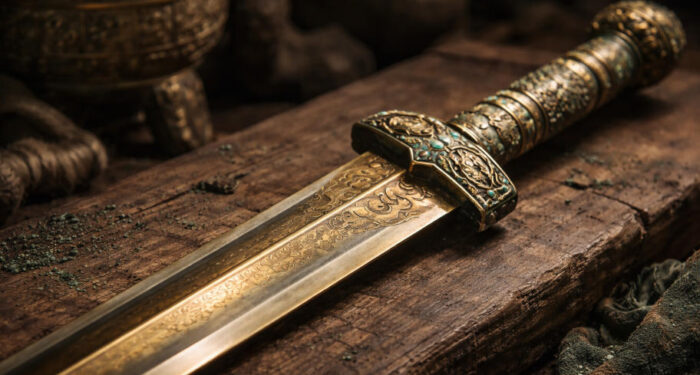
Yue King Goujian Sword
Low-tin bronze formed the flexible core, while high-tin bronze created a hard cutting edge—an early version of differential hardness, centuries before steel heat treatment.
2. How Sharp Were Bronze Swords Really?
A common myth is that bronze swords were dull.
This is simply false.
When properly polished and cold-worked, bronze edges could become razor-sharp.
Historical Proof
Greek Xiphos swords were short, lethal stabbing and cutting weapons used in brutal close combat.
The legendary Yue King Goujian Sword, buried for over 2,000 years, was found:
Untarnished
Razor-sharp
Capable of slicing through multiple layers of paper upon discovery
This artifact alone proves that bronze swords were deadly, not decorative.
3. Why Did Iron and Steel Replace Bronze?
If bronze swords were effective, why did civilizations abandon them?
The answer is economics and physics, not simple superiority.
3.1 Tin Scarcity and Cost
This was the decisive factor.
Copper is common
Tin is rare and geographically limited
Bronze production depended on long-distance trade routes
As a result, bronze swords were expensive, often reserved for nobles or elite warriors.
Iron, once smelting techniques improved, was:
Abundant
Cheap
Scalable for mass armies
Think of bronze swords as custom-made luxury weapons, and iron swords as the standard-issue gear of the ancient world.
3.2 Brittleness at High Tin Levels
Bronze is hard—but hardness comes at a price.
High tin content increases sharpness
But also increases brittleness
Bronze blades could snap instead of bending
Iron swords, even when softer, tended to deform rather than break, making them more forgiving in chaotic combat.
3.3 Blade Length Limitations
Because of brittleness, bronze swords were usually:
Shorter
Broader
Optimized for stabbing and slashing at close range
Iron and steel allowed longer blades, enabling new fighting styles and battlefield tactics.
3.4 Weight Considerations
Bronze is denser than steel.
At the same size, a bronze sword is heavier, leading to:
Faster fatigue
Slower recovery in prolonged combat
As warfare evolved, lighter steel swords became the logical choice.
4. Bronze Swords Today: From Weapons to Cultural Artifacts
Although bronze swords are no longer practical weapons, their value has not diminished—in fact, it has transformed.
4.1 Aesthetic Power: The Warm Spirit of Bronze
Unlike the cold gleam of steel:
Bronze radiates warmth and authority
Fresh bronze shines golden
Aged bronze develops rich green or dark patina
This visual character gives bronze swords a ritualistic and imperial presence unmatched by steel.
4.2 Patina: The Art of Time
Bronze is a “living metal.”
Over time, it naturally forms unique patinas—no two pieces age the same. Collectors value this as a physical record of history.
High-end replicas today use traditional lost-wax casting to recreate ancient textures and motifs that modern machining cannot replicate.
4.3 Symbolism, Feng Shui, and Display
In Eastern traditions, bronze swords symbolize:
Integrity
Authority
Protection
Displayed in homes or studies, they convey knowledge, restraint, and historical depth—without the aggressive aura of steel blades.
5. Final Verdict: Were Bronze Swords Effective?
Absolutely.
Bronze swords were not abandoned because they were weak. They were replaced because:
Tin was scarce
Bronze was expensive
Iron was easier to mass-produce
Steel eventually surpassed all previous materials
In their era, bronze swords represented the highest level of human technology—trusted by warriors, kings, and generals alike.
Understanding bronze swords deepens our appreciation of modern high-carbon steel katanas, which stand on the shoulders of thousands of years of metallurgical innovation.
Bronze was never fragile—it was simply the first step toward perfection.
https://www.coolkatana.com